

Photographs: Careers360 Amit Bansal
It is an act in creating your personal brand image. Your resume reaches the interviewer before you do and many people lose out on an interview opportunity thanks to a poorly written one.
Your resume or CV is the first step in projecting yourself effectively to the recruiter. So create an image that you genuinely identify with; it is a sharp world out there and no one will buy false niceties. Here we address 10 important issues related to your resume.
Should your resume have a career goal/objective statement?
A resume that is worthy of representing you should clearly state your career objective. A career objective is an indirect
way of advertising what you will bring to the company/role. It must display a 'giving' attitude and not a 'taking' attitude.
Take a look at this: "To achieve an appreciable status in an organisation that offers full scope for growth and
where I can fulfil my aspiration of becoming a world-class software professional."
And this: "Be a part of an organisation that recognises my skills and provides me with suitable environment to perform to the best of my ability."
Do either of the above display a 'giving' attitude? They don't. So now you know how NOT to write an objective statement! It is advisable to keep the objective statement simple and specific. Never beat about the bush. It's a waste of time and doesn't further your chances. Let it focus on the direct value addition that you can provide.
Amit Bansal is a career counsellor, trainer and CEO of PurpleLeap.What sequence should your story follow?

Be it work experience or education, always tell the story from the current/ most recent to the first. NEVER write it the other way round.
Does your resume need to mention your marital status?
The new-age resume does not require you to mention your marital status. However, if the job advertisement clearly states this as a requirement, do fulfil it.
How should you treat references?
Unless you have been specifically asked to provide references, it is acceptable to state in your covering letter/e-mail that
you will provide references on request. Usually, two references are sufficient.
Try to provide references from the two most recent phases of your career. It is a good idea to inform the referees that you are giving out their contact information. It will also help if they know what kind of jobs you are applying for.
Should you send the resume as an MS Word document or a pdf?
Photographs: Rediff Archives
Some organisations ask you to upload your resume and they usually ask for an MS Word document.
If you are mailing across your resume, you could choose either format. A word of caution: do not get carried away if you decide to make a pdf. Keep it simple leave out visual histrionics. And whatever software you choose send the resume in the most commonly used version.
The biggest advantage of using a pdf format is that it preserves the formatting irrespective of the version of the Acrobat Reader or user settings. In MS Word, however, the formatting can change based on the MS Office version and User Settings, leading to awkward situations like a two-page resume becoming a three-page document. Or a section title like Educational Background coming on Page 2 with the details going to Page 3.
However, if the company insists on a Word document, send your resume in that format only. Lots of organisations have tools to extract information from Word documents and if you do not send your resume in that format, it may not get processed at all!
Should you incorporate links in your resume?
If you are an engineer who writes a technical blog, go ahead and incorporate the link. If you are a website developer, the links to the pages created by you will certainly help.
However, spare the recruiter from links of your personal blogs, photographs and anything and everything that you scatter on the World Wide Web. In fact, providing the link to your personal blog may even prove a spoiler if you publish office gossip or crib about your job!
What sort of job profiles demand a portfolio?
Artists, designers, photographers, models and those from the performing arts need to provide a portfolio.
An artist model/ photographer/ designer may want to include a PowerPoint or pdf, while a dancer/ actor/ singer may want to mention links from sites like YouTube. Irrespective of the type of portfolio, the intention is simply to showcase your best and most relevant work.
What fonts/ presentation styles make sense?
Photographs: Uttam Ghosh/Rediff.com
Go easy on choosing fonts and presentation styles. The most acceptable ones are the simpler ones.
It is advisable to use fonts like 'Times New Roman', 'Calibri' and 'Verdana'. Do not get tempted by the fancier fonts. Your CV is not the platform to exhibit your artistic inclinations. Also, keep the fonts and font sizes uniform across different categories in your resume.
You should zero in on a presentation style with just one thing in mind -- it should be extremely presentable. By creating minimum chaos, it should elicit the maximum attention. Some people choose to give their resume a fancy header with their name and contact information in bold. This gives it a 'letterhead' look. Some go for a more conventional style by listing out such information in bullet points. Either style is fine.
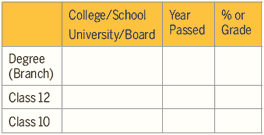
In writing about your project work, education and work experience, you could provide a box format or a neatly
tabulated one. For instance:
Academic Background
What are the worst resume gaffes?
The worst thing you could do is to send in a resume without running a grammar/ spell check. In this age of MS Word, grammar/ spelling mistakes are just not tolerated. Needless to say, a resume saved as supersexy2010.doc or rockstar.doc will be immediately trashed.
One gentleman I knew failed to get a single interview call after sending out more than 80 applications. I probed a little and was shocked to find out why -- he had sent out group mails! Do not try to pass around your resume/ covering letter without modifying it to suit the company/role you are applying for. It is offending if your application reads like:
Dear _______, I am applying for the role of ___________________ at your esteemed organisation _____________________.
It is NOT acceptable!
What is the difference in writing a resume for a BPO professional/ engineer/ MBA?
If you are a BPO aspirant, you need to highlight your ability to deal with all kinds of people, chase targets and work in shifts.
If you are an engineer, your resume should clearly talk about your projects and internships. Expect a fair number of questions from these areas in the interview.
An MBA student would need to write about projects and training.

 © 2025 Rediff.com
Comment
article