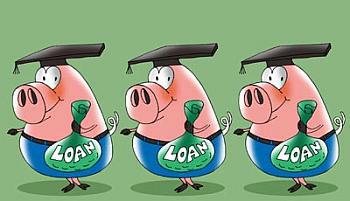
Got that personal loan at a 'cheap' flat rate of 8 per cent? You may be fooled.
Lenders often advertise flat rates, which do not reflect the actual interest you pay. You may end up paying much more than you what they tell you.
Padma Ranjan, an upwardly mobile young telecom executive, took a personal loan of Rs one lakh at a flat interest rate of 15 per cent for 36 months to buy a plasma television. Pretty lucky, she thought, to land this rate, when normal personal loan rates are in excess of 20 per cent.
But did she really manage to get it so 'cheap'? She was yet another customer who got carried away by a rate of interest that does not reflect the actual cost of her loan.
Actually, Padma would be paying an interest of 26 per cent per annum on a reducing balance basis instead of the 15 per cent that she thought she was paying. Here's how:

With an EMI of Rs 4,028, Padma's total payout over 3 years would amount Rs 1,45,000. Therefore, the total interest paid is Rs 45,000 (Rs 1,45,000 less loan amount of Rs 1,00,000). As the loan period is 3 years, the 'average' interest payout for one year is approximately Rs 15,000, which is 15 per cent of the original loan amount of Rs 1,00,000. This is how the flat rate of 15 per cent is calculated.
This calculation at 15 per cent would have been perfectly okay if she had paid the entire amount of Rs 1,45,000 at the end of 3 years in one shot. But in actual practice, she is required to pay a monthly installment of Rs 4,028 for 36 months. Which means with every payment, the principal amount of the loan should keep coming down (this is called the reducing balance method of interest calculation or the effective rate of interest).
Flat rate never reflects the actual cost of the loan. The only reason lenders ever quote a flat rate is because they are ashamed to tell you the effective rate of interest, which is much higher.
So, unless you are desperate, stay away from a lender who quotes a flat rate of interest on a loan.
Even if you are desperate, find out the effective cost of the loan before agreeing to take it. Of course the practise of quoting flat rates has reduced now that banks are no longer very keen to disburse unsecured personal loans. Also they are now required to report the effective rate to the customer in their documentation and hence find it difficult to quote a rate that is not justified in the loan documentation.
Now that you know why flat rates are never flat let us take you through some tips that could help you get the best interest rate on personal loans
Tip 1: Flat rate is humbug
If the bank is offering you a flat rate of interest, avoid it, as it never reflects the actual cost of your personal loan. Always go in for a loan with interest on reducing rate (IRR), where you will be charged only on the balance outstanding. Anything not in writing is worth nothing.
Tip 2: Negotiate, and then negotiate some more
If you have an excellent financial profile then negotiate on the personal loan interest rate, processing fees and prepayment penalty with at least three or four lenders. Get all commitments in writing. Discounts on processing fees and prepayment penalties are possible, especially if you have a salary account with the bank or are using their credit card. So negotiate hard on this.
Tip 3: There is no upper limit for interest rates, so negotiate hard
Remember that banks only have a minimum interest rate that any consumer must pay and the maximum interest rate cap is fairly high. The loan salesmen or DSAs (direct selling agents) are required to sell loans at a minimum weighted average rate of interest for the money disbursed through them. So they have a natural tendency to push customers to higher interest rates to meet their targets.
This sometimes imposes different interest rates for professionals in the same company with similar employee profiles. Be smart and savvy and get the lowest rates.

Tip 4: Interest rates vary
Banks have a clutch of varying interest rates, depending on whether the consumer is salaried or self-employed. Personal and occupation profiles are very closely scrutinised. Among the salaried, the top ten companies will have lower rates of interest. Employees within each company will have different rates depending on their salaries, personal profiles and credit history.
Self-employed professionals like doctors and chartered accountants get much lower rates of interest as compared to self-employed non-professional who have to pay a higher rate of interest due to the perceived risk involved in lending to such consumers. So, negotiate to get the lowest possible rates for the category you may fall under.
Tip 5: Submit all relevant papers and get the best out of it
One must keep in mind that until the documents are submitted, it is most unlikely that a bank would offer its best possible quote. The so-called pre-approved loans often come at a rate much higher than what the bank might be willing to accept.

Tip 6: Higher the risk, higher the interest rate
Personal loan is an unsecured loan, where the consumer provides no collateral to secure the bank's money. It is often a short-term loan sanctioned on the basis of your income and net worth as a salaried employee or self-employed professional.
Due to the higher risks involved, the interest on this product could range anywhere between 16 per cent and 35 per cent.
It will depend upon the type of consumer and the tenure of the loan. But it is better to stick to a plain vanilla loan where the interest is calculated on the reducing balance.

 © 2025 Rediff.com - Investor Information - Advertise with us - Disclaimer - Privacy Policy - Feedback - About us - Terms of use - Grievances